
Central United Methodist Church Rogers Demonstrates Calling to Love Neighbors with Multiple Living Kidney Donors and Recipients
Written by Kelli Reep
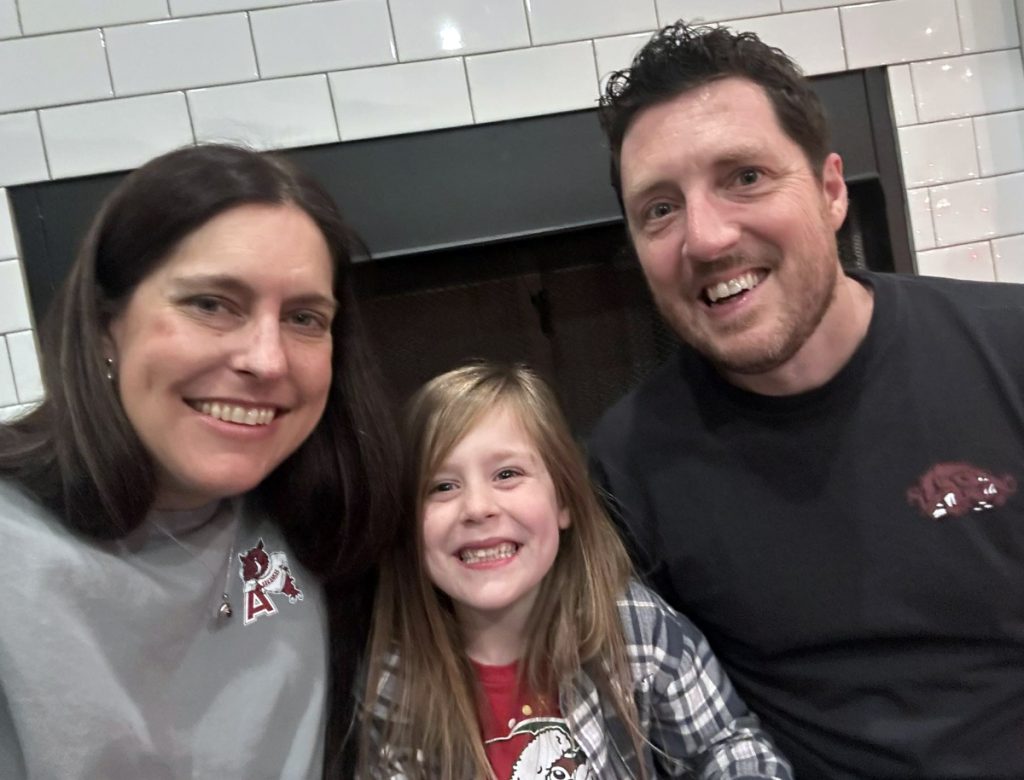
For Liz Lusk, faith has never been something she keeps tucked away for Sundays.
It’s something she lives out loud, in leadership, in service, and now, in a season of deep vulnerability and extraordinary grace.
Lusk, a member of Central United Methodist Church in Rogers, will soon receive her second kidney transplant. The donor is not a family member nor a stranger from across the country. She is someone from her own church community – a fellow believer stepping forward to offer the most personal gift imaginable: life.
“I don’t even know what to say,” Lusk shared. “How do you say thank you? It feels hollow. This isn’t like receiving flowers.”
Lusk was diagnosed years ago with polycystic kidney disease (PKD), a genetic condition that causes cysts to develop on the kidneys and eventually leads to kidney failure. Her mother had the disease, so she always suspected it might be part of her own story, but it wasn’t until later that she received confirmation.
For nearly a decade, she lived well and managed the disease. But at age 35, her kidney function dropped to the point where she needed a transplant.
Her husband, Robbie, volunteered immediately.
“He was the first one tested,” she said with a laugh. “Everyone was like, ‘That’s amazing!’ And I was like… well, I live with him.”
Her husband was a match, and the transplant gave Lusk more than renewed health: it gave her a future.
“Robin gave me a kidney,” she said, “and we were able to have a baby. We had tried for a decade.”
The transplant worked beautifully for more than ten years, but her health began to decline again, not because of PKD this time, but because her body began rejecting the transplanted kidney.
She explained it as something called antibody-mediated rejection, a condition where the immune system continues to fight the transplanted organ even with immunosuppressant medication.
“I tell people my immunosuppressants made the kidney like a wolf in sheep’s clothing,” she said. “But the wool started slipping. My body started saying, ‘Hey, this isn’t original equipment.’”
Doctors tried everything: medication adjustments, intensive treatments, even plasma exchange. But despite every effort, her body continued to attack the kidney.
As Lusk began the process of evaluation for a second transplant (this time through the Mayo Clinic in Minnesota), someone from Central UMC quietly began testing as a potential donor.
The donor initially referred to herself as a “backup.”
After confirmation mentoring at church, she approached Lusk and told her she wanted to be tested, just in case. Confirmation or peer mentoring in kidney transplants involves trained, experienced transplant recipients or donors providing confidential, one-on-one, emotional and informational support to candidates, potential donors and their families. It helps patients navigate the process, adhere to care plans and reduce anxiety.
Lusk was stunned.
“And I was like… ‘Excuse me, what?’”
Because living donation is so carefully protected, Lusk could not be involved in the process. She couldn’t ask questions, couldn’t offer to pay for travel, couldn’t even speak too much about it for fear of seeming coercive.
“I really was just careful on what I said,” she said. “I just had to stand back until it was done.”
Then, on Christmas Eve, the call came.
“She called me and said, ‘I’ve got good news for you. I’ve been approved. I’m a match.’”
That evening, Lusk went to worship surrounded by a congregation that wasn’t just offering prayers but carrying the weight of the moment alongside her.
“It was great to go to church that night and be completely supported by a congregation who is concerned for and loves us both.”
Lusk says this isn’t the first time Central UMC has witnessed the power of living donation.
In fact, she shared there have been multiple kidney donations connected to the church, a rare and remarkable testimony to generosity and faith in action.
“It’s the fourth in our church,” she said. “Four donors and two recipients.”
In her eyes, it’s not a coincidence. It’s what happens when a community takes seriously the call to love one another.
Lusk’s transplant surgery is now scheduled for March 23 at the Mayo Clinic, moved up two days from its original date. Her donor will undergo surgery first with Lusk being prepped immediately afterward.
“They take her in about an hour before,” Lusk explained. “Then they come get me, and they pump me full of steroids to get my immunity really low. They walk over the kidney to me, and it starts making urine before they even sew me up.”
Even after all she’s been through, Lusk still speaks with awe about the miracle of modern medicine and the sacredness of what a living donor provides. Unlike her first transplant, which happened preemptively, Lusk has been on dialysis while awaiting surgery. She initially tried home dialysis, hoping it would be easier to manage, but it became physically exhausting and emotionally draining.
“I didn’t want to do dialysis,” she admitted. “Nobody wants to do this, but the last thing we needed was to get up there and find out I couldn’t have surgery.”
But her determination is clear: she’s doing what she must to stay strong and ready for surgery, not only for herself, but also for the donor who is making the journey with her.
Through every stage of her health journey, Lusk has also felt called to help others walking the same road. She has worked with the National Kidney Foundation and has encouraged others to seek living donors and not lose hope. Her guiding scripture comes from 2 Corinthians 1:4: He comforts us in all our troubles so that we can comfort those in any trouble with the comfort we ourselves receive from God.
“That is why I’m here,” she said. “I truly believe God wants me to help people understand that living donation is possible, that it is not scary and that you can literally change someone’s life.”
She believes God made her an extrovert for a reason, and she is using that gift to bring awareness, encouragement and hope to others.
This transplant will impact not just Lusk and her donor, but the entire Central UMC community. Even their pastor is planning to be there.
“Our pastor is driving up to be with us,” she said. “Rob Holifield has already said, ‘I’ve got two members of my church having surgery. I’m driving to Minnesota, and I will be there for them.’”
For Lusk, it’s another reminder that she isn’t walking this road alone.
When asked about receiving such a gift again, Lusk doesn’t try to wrap it in easy words. She doesn’t pretend it’s simple.
Instead, she honors it for what it is: holy. A living donor. A church family. A body tired from battle. A heart anchored in Christ. And a story still unfolding, one filled with courage, community and the unmistakable presence of grace.