
written by James Sawyer, Pinnacle View UMC communications director
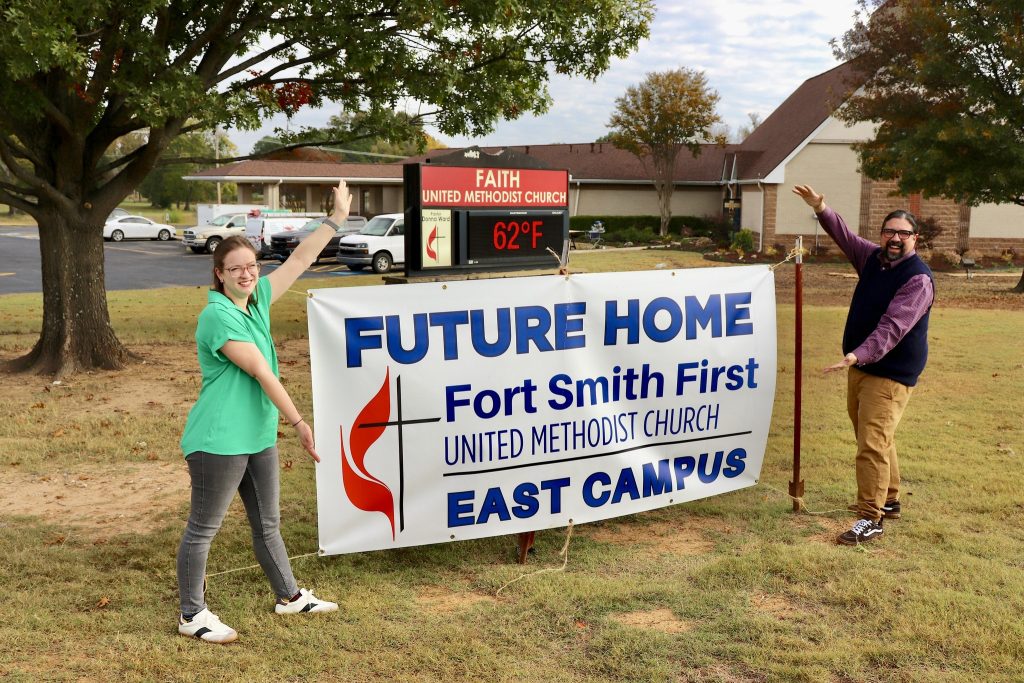
When the members of Fort Smith First United Methodist Church (FSFUMC) and Faith United Methodist Church began talking earlier this year, they weren’t just planning an administrative merger. They were listening for the Spirit’s whisper of resurrection.
Today, that whisper has become a song of new life. The former Faith UMC has been renewed as East Campus of First United Methodist Church—a vibrant extension of Fort Smith First’s ministry. What began as a hard but hopeful conversation has become a living witness to the power of connection, courage, and God’s unending creativity.
“We’ve become one church in two locations,” says Rev. Blake Bradford, senior pastor of FSFUMC. “This isn’t just about remodeling a building or helping another congregation survive. It’s about creating new life—serving neighbors with compassion, welcoming all with open hearts and minds, and growing disciples of Jesus Christ.”
A Spirit-Led Beginning
The journey began with prayerful conversations between Faith UMC’s leadership and District Superintendent Rev. Roy Beth Kelley. Faith’s congregation had long served faithfully in East Fort Smith, but sustaining ministry alone had grown difficult. They began to ask what it might look like for their property and mission to continue as part of something larger.
At the same time, Fort Smith First UMC was discerning how best to extend its reach eastward as the city grew in that direction. “When Bishop Merrill and the Conference encouraged us to explore the possibility, it became clear this was more than logistics—it was a calling,” Bradford recalls.
What followed was a careful, Spirit-led process involving both congregations in prayer, study, and open dialogue. Each church brought unique gifts and histories, but they shared a common hope: to see United Methodist ministry thrive in the River Valley.
Discernment and Transparency
For both congregations, discernment began with prayer. Fort Smith First used daily “Breakthrough Prayers,” hosted town halls, and employed conversation tools such as Six Thinking Hats to explore every aspect—facts, feelings, hopes, and fears—without rushing conclusions.
Transparency became a cornerstone. “Every document, timeline, and cost estimate was shared with our congregation,” Bradford explains. “That radical openness built trust even when we didn’t yet know all the answers.”
Rev. Abbey Maynard, FSFUMC’s Executive Pastor and now Campus Pastor for the new East Campus, led conversations with compassion and clarity. Under her guidance, the staff and lay teams stayed grounded in prayer while imagining new ministry in East Fort Smith.
Generosity followed vision. Lead donors quickly pledged $300,000 toward renovations, with an additional $90,000 three-year grant from the church’s foundation. Those gifts allowed the project to include essentials and enhancements that created a flexible, inviting worship space for the next generation of ministry.
Faith and Fortitude
By late summer, both congregations voted unanimously to move forward. A Legacy of Faith Service celebrated the witness of the former Faith UMC and commissioned the congregation into its new life as part of First Church. Bishop Laura Merrill preached a message of resurrection hope as members symbolically offered their legacy to God’s future.
“The courage and sacrificial faith of Faith UMC’s members has been inspiring,” Bradford says. “They didn’t simply close a chapter; they chose to plant a seed.”
Transformation moved quickly—sometimes literally overnight. Faith’s long-running Backpack Food Ministry, serving children across multiple schools, was moved downtown so there would be no interruption. Volunteers hauled boxes, rewired classrooms, and prayed amid construction dust. Trustee Dwight Curry—a hotelier by trade—served as project manager, turning the remodel into a ministry of stewardship and hospitality.
Change, of course, came with challenges. Walls came down, pews were removed, and timelines were tight. But as one member said, “Paint means progress.” Members from both congregations worked side by side—sharing pizza amid the sawdust and remembering that the work was about people, not property.
Building One Family
Intentional relationship-building has been key to forming a shared identity. Under Rev. Maynard’s leadership, two Launch Teams—“Serving Neighbors” and “Worship & Welcome”—bring members from both campuses together to serve, dream, and pray. Their first outreach was a booth at Woods Elementary’s Halloween festival, handing out candy and invitations to the upcoming Christmas Family Festival.
“Shared mission builds family,” says Bradford. “As people serve together, they become the church together.”
Several leaders from the former Faith UMC now serve on FSFUMC committees, ensuring their voices remain central. Meanwhile, ministry partnerships with nearby schools are already forming. Plans are underway for a Homework Club with Woods Elementary, staffed by retired teachers and supported by the United Methodist Men.
From Maintenance to Mission
The adoption merger exemplifies the United Methodist conviction that the church exists for mission, not maintenance. In a time when many congregations face decline, the Fort Smith story offers a model of resurrection hope—a way forward rooted in connectional strength and creative collaboration.
“This is the power of our United Methodist connection,” says Rev. Bradford. “Faith UMC’s generosity, First Church’s courage, and the Conference’s shared vision all came together so that ministry could continue and grow.”
The Methodist Foundation for Arkansas (MFA) has played a vital role through its Emerging Partnership Grant, providing leadership coaching and spiritual direction during merger discernment. “The Conference’s approach—combining coaching with required spiritual direction—has been transformational,” Bradford says. “It’s helped me grow as a pastor and leader, holding both tenderness and clarity in the same hands.”
A Vision for the Future
As the finishing touches go up on the East Campus, excitement continues to build. A “teaser” worship service will preview the renovated space later this month, with regular 9:00 a.m. worship beginning in December and a Christmas Eve service at 2:00 p.m.
The East Campus will serve as a ministry hub—a place for worship, discipleship, and community gatherings. Bradford envisions children laughing in Homework Club, neighbors meeting for small groups, and families discovering a new spiritual home.
“This campus isn’t meant to compete with our downtown campus—it complements it,” he says. “We’re one church, united in heart and mission. My prayer is that our story will inspire others to trust that God can breathe new life where some see endings.”
Resurrection Hope for the Connection
For churches across the Arkansas Conference considering new models of ministry, the Fort Smith story shines as a beacon of possibility. When congregations embrace collaboration, transparency, and prayerful discernment, God creates something greater than either could imagine alone.
“This is resurrection hope in action,” says Bradford. “Because one church said yes to God’s call and another dared to dream beyond its walls, a new witness of grace is rising in East Fort Smith. And that’s what the church is all about.”