
One of the big multi-piece legislation items at the Postponed 2020 General Conference has been the Revised Social Principles. The Social Principles have been a part of the United Methodist Church since the time of Wesley but began as the Methodist Social Creed that was created as a response to the unfair treatment of children and adults during industrialization in the United States.
The Social Principles are defined as “social teachings of the (United Methodist) Church as part of the tradition of addressing complex social issues of the day,” according to the General Board of Church and Society. The Social Principles have also been referred to as the “ethical aspirations for the common good in our public policies and personal commitments” through which we “love God with our whole heart, mind, soul and strength and love and desire for our neighbors what we desire for ourselves.” (Matthew 22:37-40, Mark 12:30-31).
The revised Social Principles presented to the Postponed 2020 General Conference in Charlotte, NC, is the first complete revision in over 50 years, per UMNews. It is 20 pages shorter (43 pages total) than the previous version and the document is divided into four sections: community of all creation, economic community, social community, and political community. Find a published FAQ here.
Although not considered Church law, the Social Principles are legislative statements approved by the General Conference and included in the Book of Discipline and the Book of Resolutions. The only authority that can update or change the Social Principles is the General Conference, the church’s highest decision-making body.
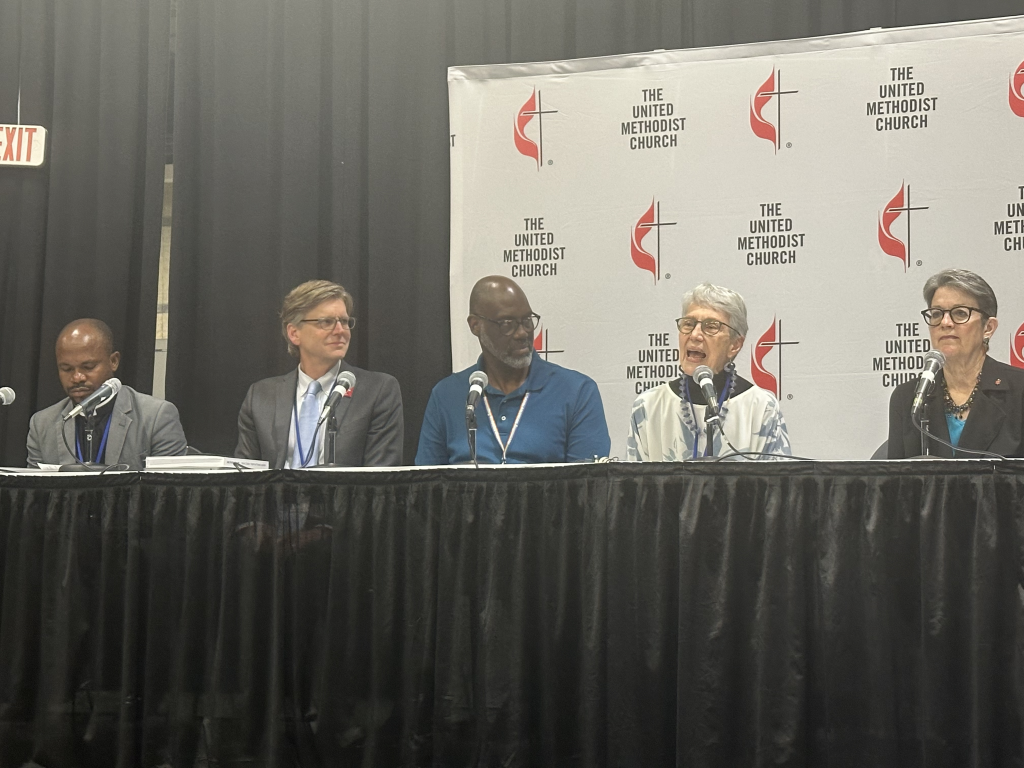
In a press conference earlier this week, John Hill, interim General Secretary for the General Board of Church and Society, and President of the General Board of Church and Society, Bishop Sally Dyck shared that the newly revised Social Principals will go into effect, unless specified, on January 1, 2025. Dyck added that the Social Principles are “there to help us live out our faithful lives to Jesus.”
Different sections of the Revised Social Principles have been introduced and adopted throughout General Conference in Charlotte. On Thursday, May 2, the last sections were adopted by the body. Bishop Sally Dyck, shared that “It has taken 12 years and over a thousand people’s input to get to this point.”
“This is a gift from the church to the church. It’s a gift of social witness,” shared Dr. Mary Elizabeth Moore, Dean of The Boston University School of Theology and coordinator for the 52-member writing teams.
The writing team of the Revised Social Principles represents the following conferences: The Philippines Central Conference, Africa Central Conference, Congo Central Conference, West Africa Central Africa, Central, and Southern Europe Central Conference, Northern Europe, and Eurasia Central Conference, and the five US Jurisdictions.
Dr. Randall Miller, Chair of the RSP Task Force shared in a press conference, “It was an amazing undertaking with visits and consultations all around the world… and to see that all of the input for this global church document has been received and welcomed is refreshing.”
Rev. Ande Emmanuel of the Southern Nigeria Annual Conference writing team added, “I am so grateful for what has happened today. As part of the writing team, I see relevancy and inclusivity for all and respect (for) each context of our global connection. The voice of Africa, Europe, Philippines are part of this.”
“They (Revised Social Principles) are a love letter seen as a sign of hope for this connection. This (the adoption of the RSP) will expand and support ministry and I am grateful for the clarifying amendment on marriage for the central conferences,” offered John Hill, interim General Secretary for Church and Society. “By God’s grace, it has taken twelve years to write, and yet the writers speak to the times right now… It’s a beautiful love letter.”
Speaking on the amendment made today, Dr. Miller shared, “The amended change in the words on marriage – or the definition of marriage, came from someone on the new judicial council. Someone who is trying to bridge cultures and make space for all cultures. Instead of trying to divide us, I saw that as building bridges and providing space for all of us.”
The amended wording now says: Within the church, we affirm marriage as a sacred lifelong covenant that brings two people of faith, an adult man and an adult woman, or two adult persons of consenting age into union with one another.
When asked why they thought that the wording of “consent” was added to the wording, Dr. Miller shared that this was supporting the African context and the issue of child marriage. “This is to be sure that marriage happens between adults only, in an effort to prolong the lives of young girls and women’s safety during pregnancy and childbirth.”
Miller added, “Consent is key in sexual ethics. Having mutual respect for others is key. This can protect minors being forced to marry at a young age.”
Bishop Dyck encouraged individuals and churches to go ahead and start studying them.
Dr. Moore added, “Now we have four years for people to live with and live into them (until the next General Conference).”
The Revised Social Principles English version, as presented to the General Conference may be found here. The final version, with adopted amendments, will be available by January 1, 2025.